October 16, 2026 Ixmore Art
For luxury shopping malls, custom Christmas installations are more than seasonal decorations. They create a setting for brand storytelling and help attract visitors. The Dior Christmas installation featured a multi-tiered Christmas tree with a gingerbread-inspired finish as its centerpiece, complemented by a circular brand logo, illuminated botanical sculptures, and smaller Christmas trees arranged throughout the mall atrium across multiple levels. As a manufacturer specializing in custom installations and props for commercial spaces, Ixmore Art managed the project from concept development and factory fabrication through international shipping and on-site installation. This article outlines the end-to-end process from an engineering and production perspective, offering practical reference points for brands, mall operators, and overseas procurement teams.
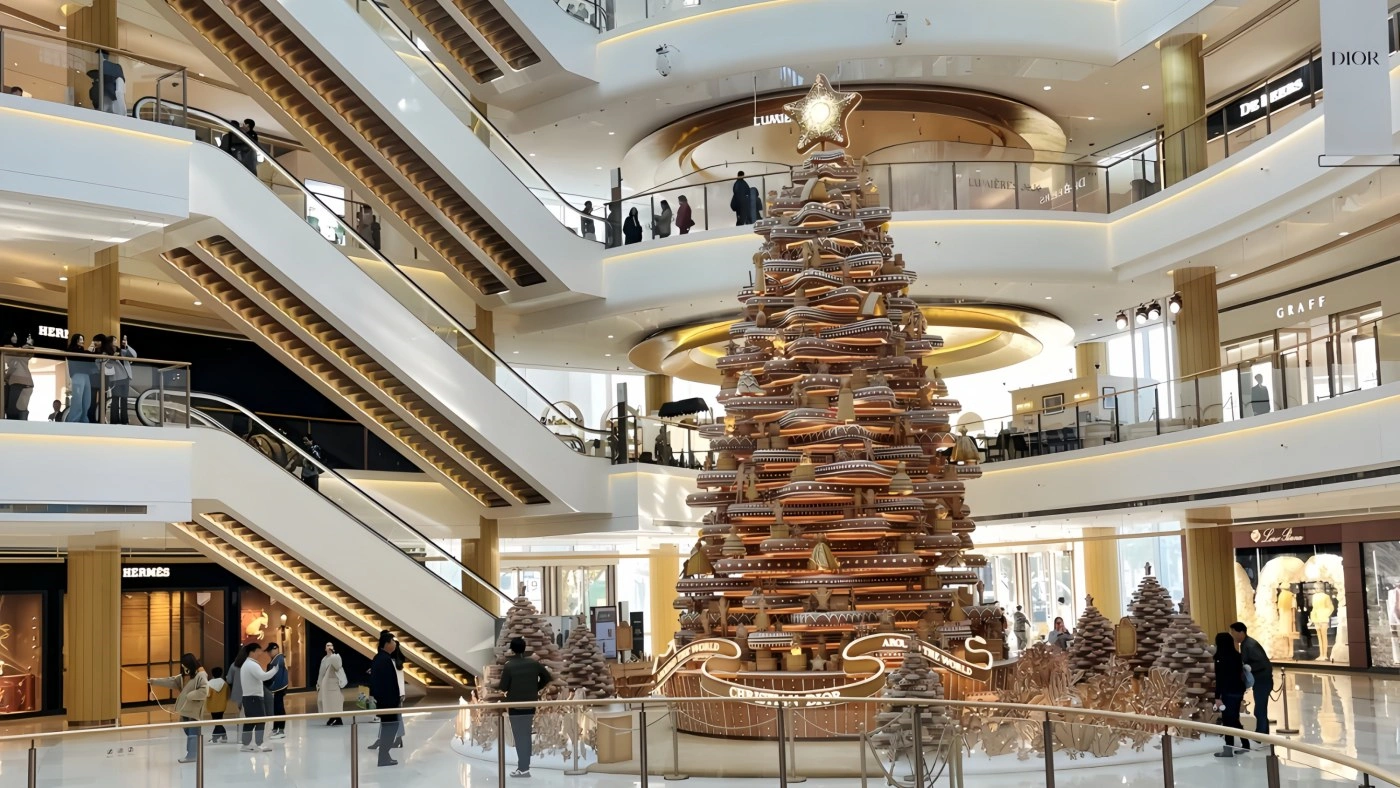
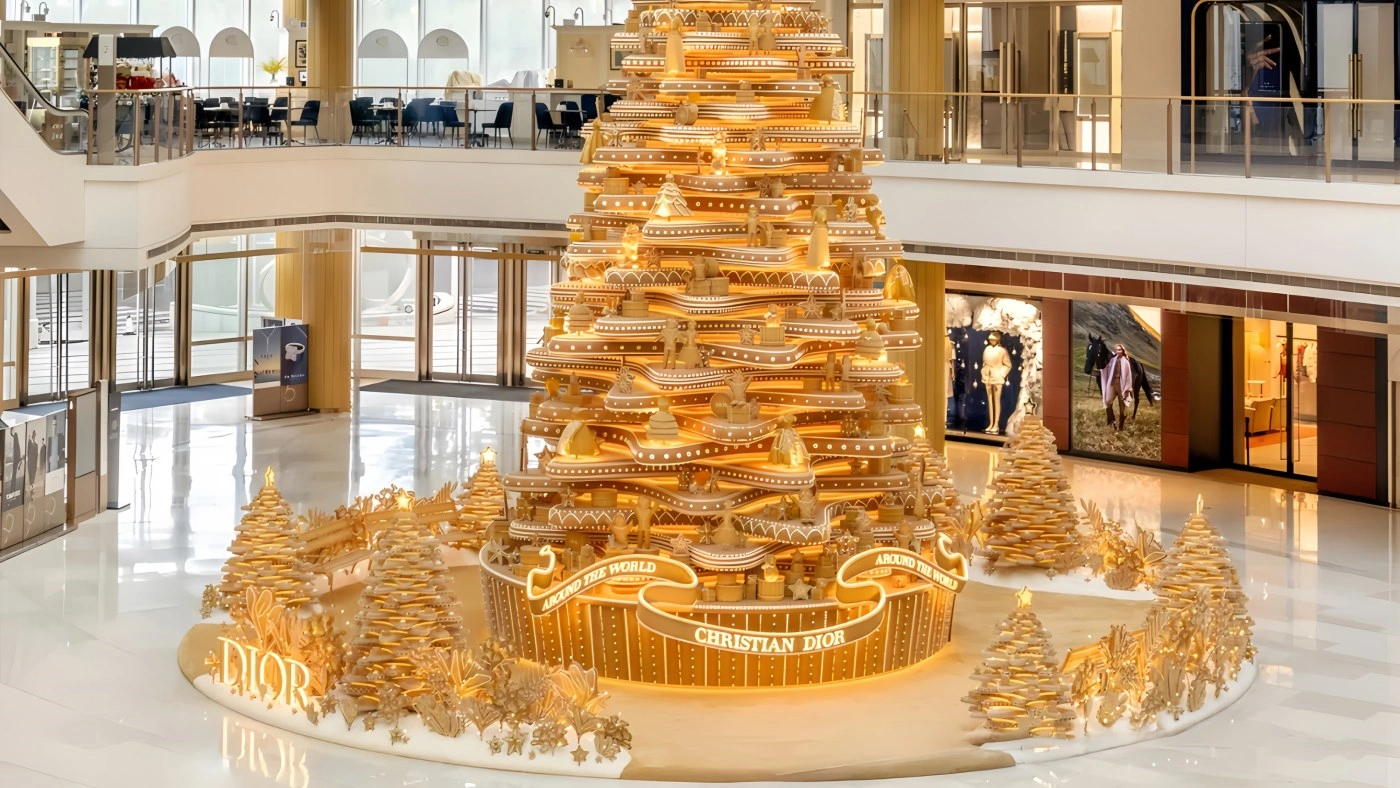
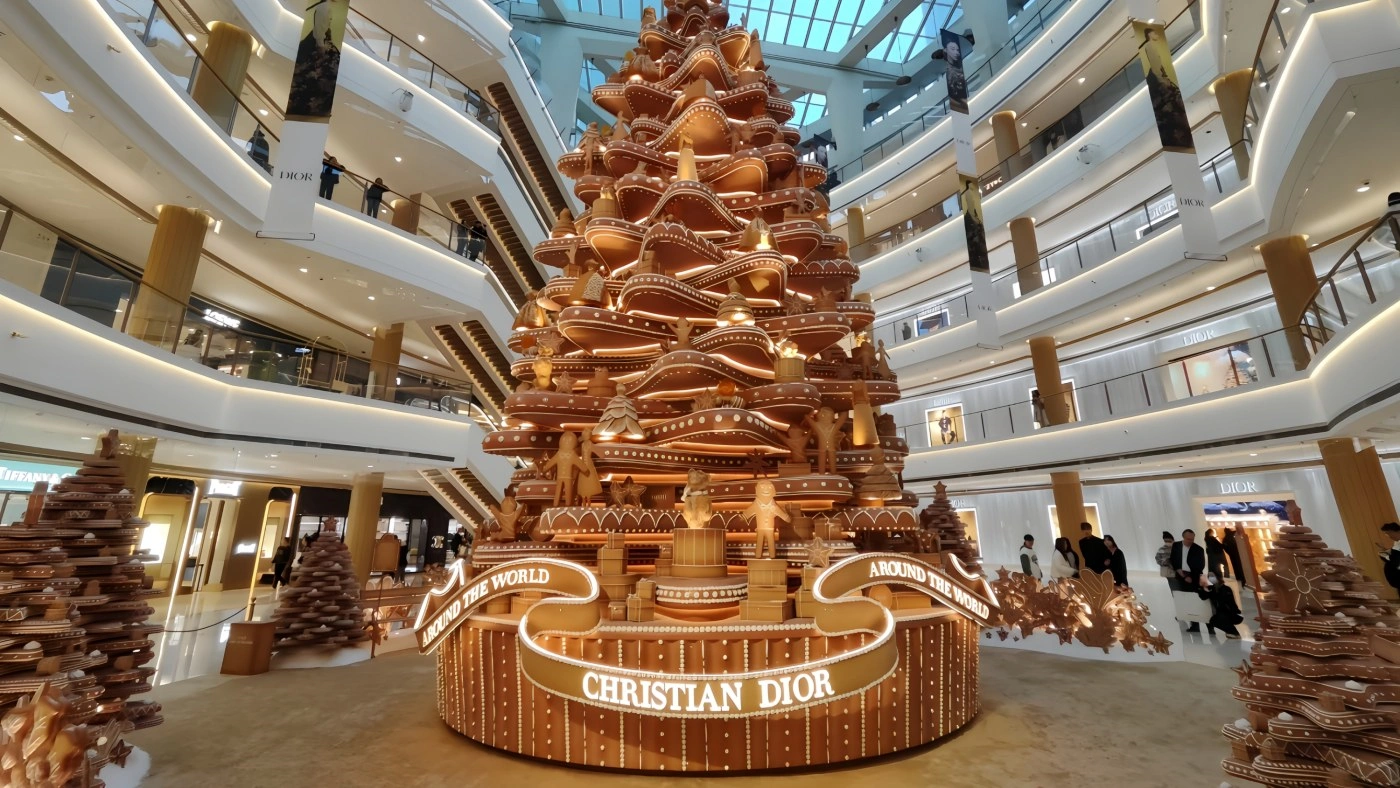
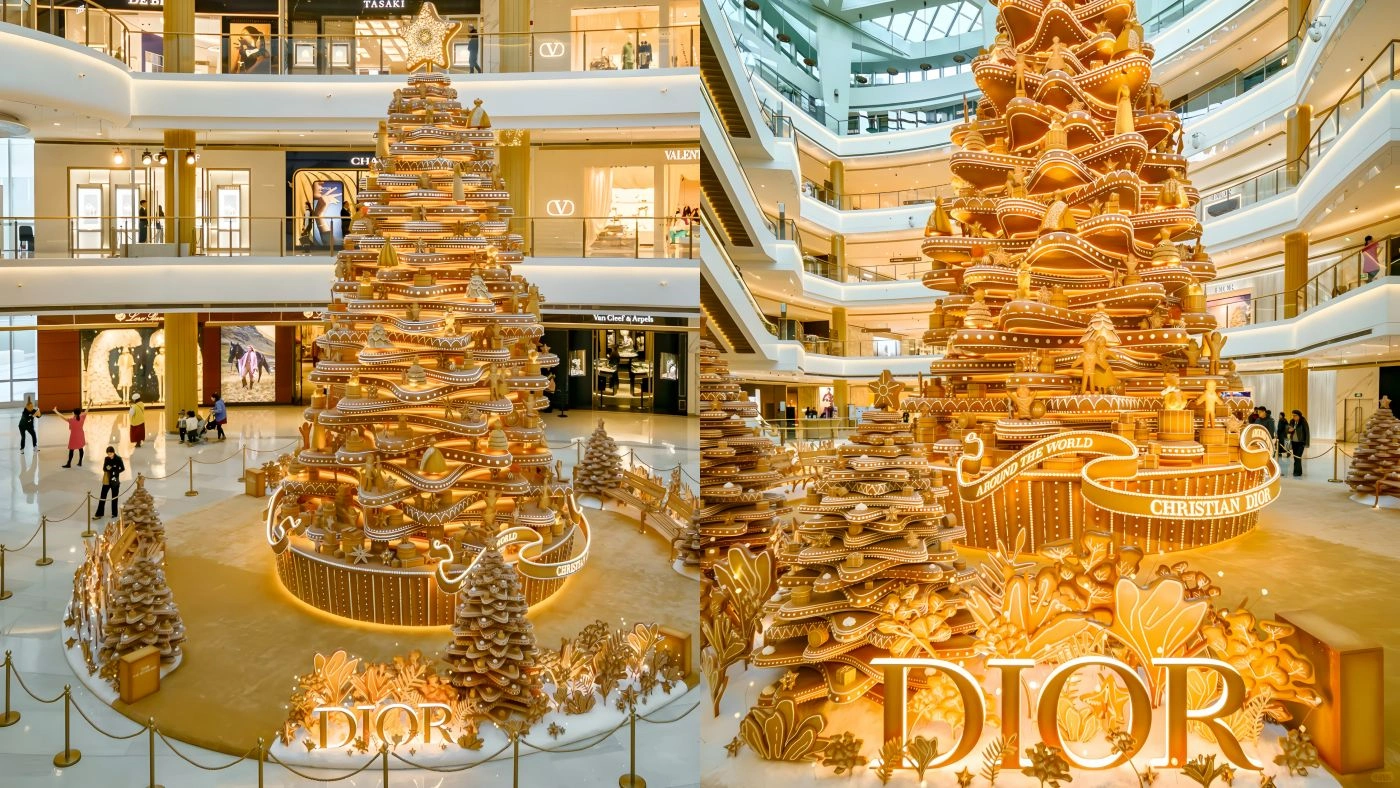
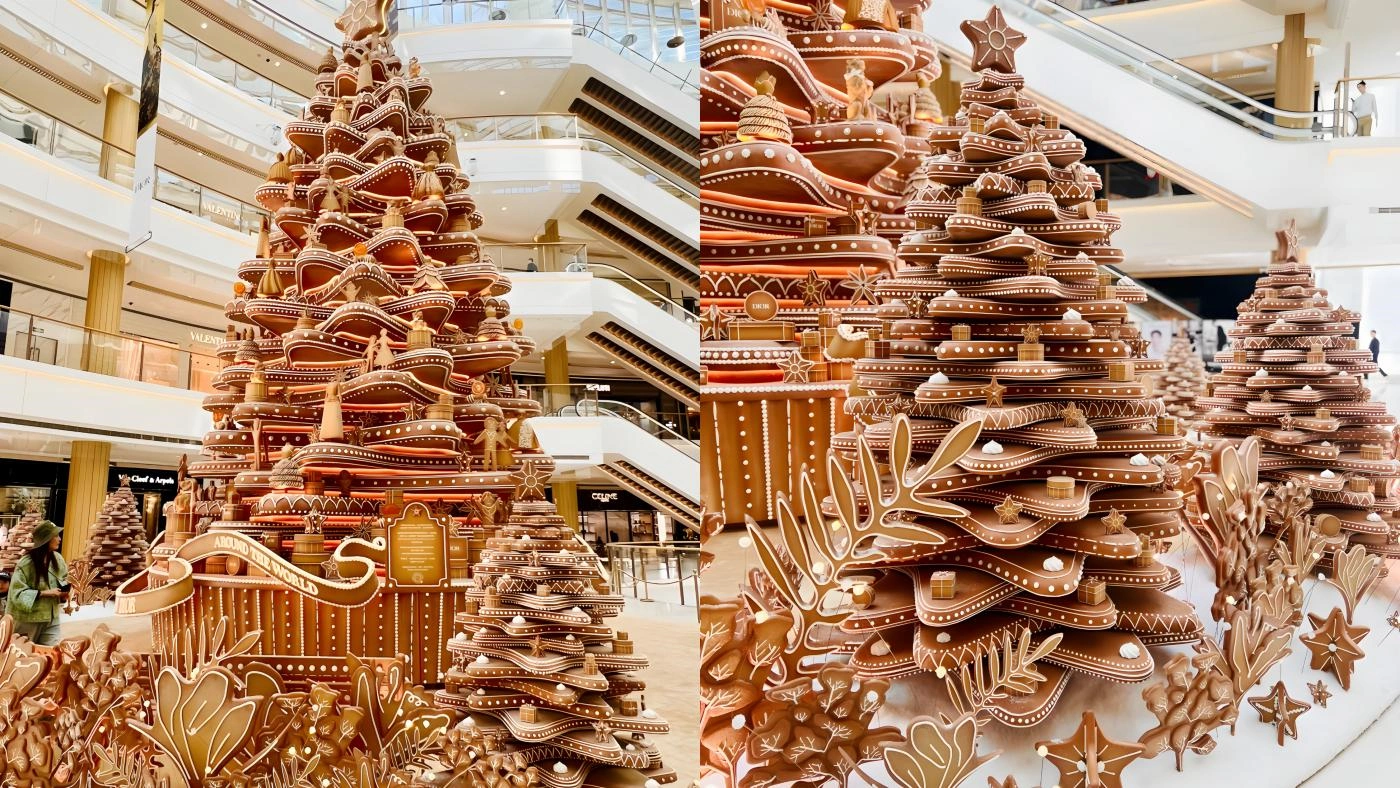
The centerpiece of the Dior Christmas installation was an oversized gingerbread-style Christmas tree made up of multiple tiers of undulating panels. Polka-dot icing details decorated the panel edges, while gingerbread figures, gift boxes, and small tree-shaped ornaments were arranged between the tiers. At the base, a circular plinth was framed by ribbon-style signage, and warm golden LED strips traced the contours of each tier.
The surrounding display included several smaller Christmas trees, botanical leaf motifs, and illuminated brand logos, bringing the entire Christmas scene together. Smaller trees in the same visual style were also displayed in the brand’s store windows, creating a cohesive visual connection between the public atrium and the retail storefront.
A multi-level atrium presents a wide range of viewing angles. The installation needed to look refined whether viewed from the ground floor or from the upper levels. At the same time, despite its substantial scale, the display had to comply with the mall’s strict requirements for floor loading, construction hours, fire safety, and clear evacuation routes. The scheduled holiday opening date was fixed, leaving little room for delays.
For these reasons, the custom Christmas installation had to be planned as one coordinated system covering design, structural engineering, fabrication, logistics, and installation, rather than as separate tasks handled independently by multiple subcontractors. This integrated approach has long been central to our project management process for large-scale festive installations in commercial spaces.
Before production begins, the team needs accurate information about the atrium floor plan, clear ceiling height, floor load capacity, available suspension points, freight elevator dimensions, access routes, and permitted construction hours. These details directly affect how the installation is divided into modules and the maximum weight allowed for each component. For overseas projects, we often work with local partners to carry out site surveys. We then cross-check the findings against drawings, photographs, and measured dimensions to reduce the risk of making design decisions based on visual estimates alone.
After the design renderings are translated into construction drawings, the main tree is divided into practical modules, including the frame, tiers, base, and decorative elements. Each module must meet three requirements: it must be feasible to fabricate in the factory, fit within the planned shipping configuration, and pass through the site’s freight elevators and access routes. This stage draws heavily on our experience in custom Christmas installation production. Even when the overall design remains the same, a different approach to modularization can significantly affect shipping costs and installation efficiency.
The steel frame serves as the installation’s primary load-bearing structure, with the decorative panels secured to it. Strength and stability calculations are required to help ensure that the installation remains stable and resists deformation, including in areas where visitors may approach it closely. The engineering principles are consistent with the load calculations and anti-toppling measures we apply to outdoor installations, although indoor projects place greater emphasis on protecting the floor and controlling the structure’s center of gravity.
The wave-shaped panels are typically carved from foam and then reinforced with fiberglass or a hard coating. They are finished with hand-painted details, spray-applied colors, and a textured, matte surface to create the intended gingerbread effect. The main production challenge is maintaining a consistent finish across large, repeated forms. The color, texture, and edge thickness of every tier need to match; otherwise, differences can become especially noticeable when the installation is viewed from a distance across the atrium.
Warm golden LED strips are integrated along the lower edges of the panels. Together with the illuminated brand logos and ribbon-style lettering, they create the installation’s main nighttime visual effect. To support efficient on-site connections and future maintenance, the lighting system needs clearly organized wiring, numbered connections, and accessible service panels. Brand logos also require precise control over color, typography, and proportions. Before full production begins, these details must be checked against the brand’s specifications and approved artwork.
Before shipment, every module should undergo full or partial pre-assembly at the factory. The checks cover connection interfaces, dimensions, lighting performance, and surface finish. Factory pre-assembly is an important way to reduce uncertainty at overseas installation sites, where correcting a problem can be considerably more expensive and time-consuming than making the same adjustment before dispatch.
Each module is labeled according to its floor, installation zone, and assembly sequence, with a corresponding packing list and installation diagram. Fragile decorative pieces are protected with custom foam inserts and wooden crates. Large panels are packed flat in layers to reduce the risk of deformation caused by pressure. A clear labeling and numbering system helps the installation crew identify and retrieve each component quickly, which is particularly important when the available on-site construction window is limited.
When wooden crates or pallets are used, they must meet the applicable requirements of the International Standard for Phytosanitary Measures No. 15 (ISPM 15). Established under the International Plant Protection Convention (IPPC), the standard is intended to reduce the risk of quarantine pests being transported in wood packaging. Raw-wood packaging materials generally need approved treatment and the required compliance mark, while processed wood products such as plywood are generally exempt. Checking packaging requirements before export helps reduce the risk of shipments being held or returned at the destination port.
The international shipping plan needs to be agreed in line with the applicable trade terms. Incoterms®, published by the International Chamber of Commerce (ICC), comprise 11 trade rules that clarify the responsibilities of buyers and sellers for delivery, costs, and the transfer of risk. The edition referenced for this project is Incoterms® 2020. We confirm the agreed terms with the client during quotation so that responsibilities for transportation, insurance, and customs clearance are clearly defined before shipment.
Shopping centers commonly require installation work to take place outside regular business hours. Construction plans, crew lists, and insurance documentation may also need to be submitted in advance. Once the team arrives on site, the first steps are to protect the floor, establish a safety perimeter, and move the components into position in numbered batches according to the planned assembly sequence. This organized process helps minimize disruption to the mall’s day-to-day operations.
Installation proceeds from the bottom up. The crew first secures the base and central frame, then attaches the decorative panels tier by tier, and finally installs the star-shaped top decoration, surrounding trees, and botanical features. Work at height is carried out from a lift platform under the supervision of a designated safety officer. After assembly, the team checks each connection point to confirm that the components have been properly secured.
Once the structure is assembled, the team tests the lighting system, checking the brightness, color temperature, and switching sequence of each LED strip. The overall appearance is also reviewed under nighttime lighting conditions. A joint inspection is then carried out with the mall’s management team and the brand representative. At handover, the team provides the operation and maintenance manual, spare lighting components, and a list of wear-and-tear parts to support reliable operation throughout the holiday season.

Materials used in installations for public spaces must comply with the fire safety requirements that apply at the destination. In North America, for example, ASTM E84 is commonly used to evaluate the surface-burning characteristics of building materials, including flame spread and smoke development. Its results are comparative measurements and should not, on their own, be taken as proof that a material is non-combustible. Requirements differ by region, so we confirm the applicable standards with the client during material selection and provide material test reports when required. Electrical components and lighting systems must also comply with local electrical codes and have appropriate insulation and protection.
This project reinforces three factors that are critical to delivering high-quality, large-scale Christmas installations successfully. First, disassembly, transportation, and on-site assembly need to be considered during the design stage so that venue constraints do not compromise the intended result. Second, factory pre-assembly and systematic component numbering help identify and resolve potential issues before the shipment reaches the site. Third, installation schedules, safety requirements, and fire codes must be managed through established procedures rather than last-minute improvisation.
Ixmore Art specializes in custom installations and props for shopping malls, holiday events, public art projects, and pop-up spaces. Our services cover the full process, from concept development and factory fabrication to transportation and on-site installation. If you are planning a seasonal campaign for an overseas shopping mall and need a reliable partner for a custom Christmas installation, contact the Ixmore Art team. We can develop a practical technical solution tailored to your venue conditions and budget.
The schedule depends on the project’s scale, design complexity, and shipping method. For large installations, we recommend starting several months in advance and building in contingency time for ocean freight, customs clearance, and on-site assembly. Confirming the venue specifications and design direction early helps reduce overall project risk.
Yes. We plan the module sizes around freight elevator dimensions, access routes, container specifications, and the maximum permitted weight for each component. The modules are then checked through factory pre-assembly to help ensure that final assembly on site proceeds smoothly.
Damage prevention relies on zone-based packing, custom protective inserts and crates, clear module numbering, and appropriate container loading. Fragile decorative components are packed separately, while large panels are laid flat in layers. We also photograph and document the packed components before shipment to support traceability if a shipping issue arises.
For projects with complex structures or extensive lighting systems, we recommend arranging on-site guidance from technical personnel or coordinating with the local installation crew remotely. The most suitable approach depends on the project’s scale and the construction requirements at the destination.
Yes. Installations in public spaces generally need to comply with the fire safety codes that apply at the destination. The relevant requirements should be confirmed during material selection, and any required test reports should be prepared in advance to help avoid problems during the mall’s inspection.
In addition to Christmas installations, we produce custom installations and props for mall holiday campaigns, public art projects, pop-up stores, and brand experience spaces. These projects follow the same integrated workflow, from design and fabrication through transportation and on-site installation.
July 27, 2026
July 27, 2026
July 27, 2026
July 27, 2026
July 27, 2026
July 27, 2026
July 27, 2026

July 26, 2026
July 26, 2026
July 26, 2026
July 26, 2026
July 26, 2026
July 26, 2026
July 26, 2026
July 26, 2026
July 26, 2026

July 26, 2026
July 25, 2026
July 25, 2026

July 25, 2026