October 15, 2026 Ixmore Art
A successful custom mall installation is never just a matter of producing renderings. It requires weaving creative intent, structure, materials, lighting, logistics, and on-site installation into a single, controlled engineering process. The Cartier “Fantasy Winter” project is a case in point: a red-themed Christmas tree rising through a multi-level atrium, accompanied by an oversized red jewelry gift box, an illuminated leopard silhouette, a Christmas cottage, and a snow-capped mountain base. The installation was designed not only to create a commanding visual focal point amid heavy foot traffic, but also to satisfy the strict structural safety, fire code, and scheduling requirements of a commercial venue. As a China-based manufacturer specializing in custom installations and props for commercial spaces, Ixmore Art has compiled its end-to-end experience, from factory fabrication through freight to on-site installation, as a reference for brands, mall operators, and planning agencies preparing large-scale mall installation projects.
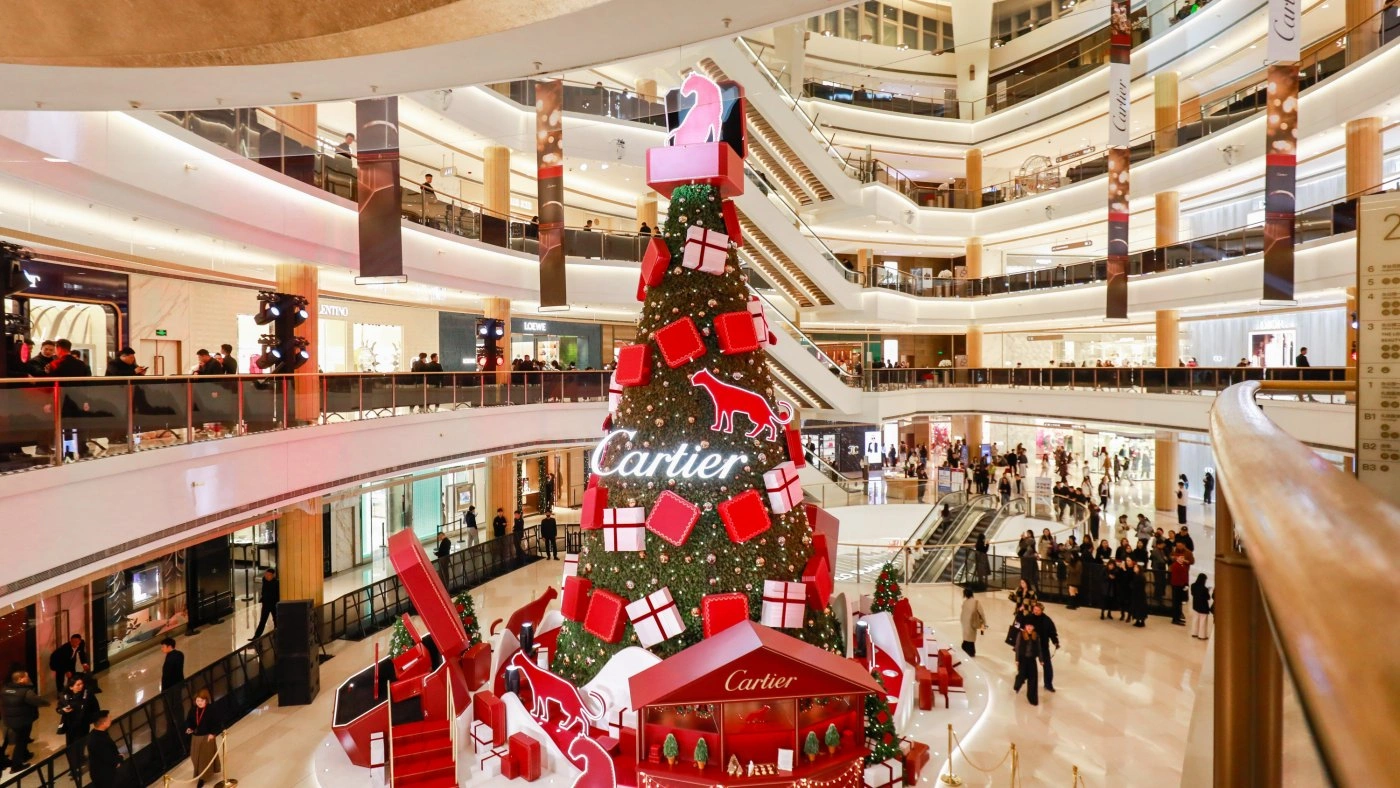
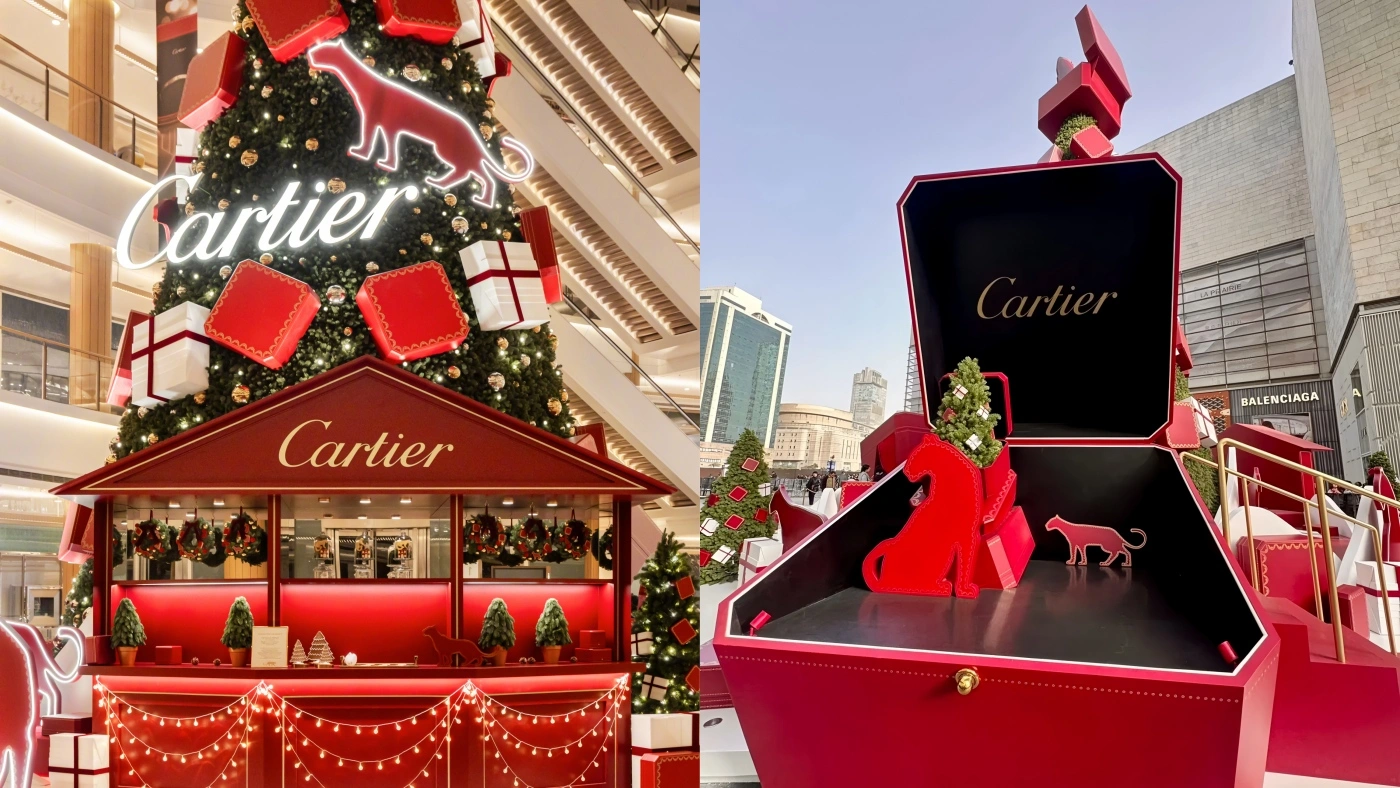
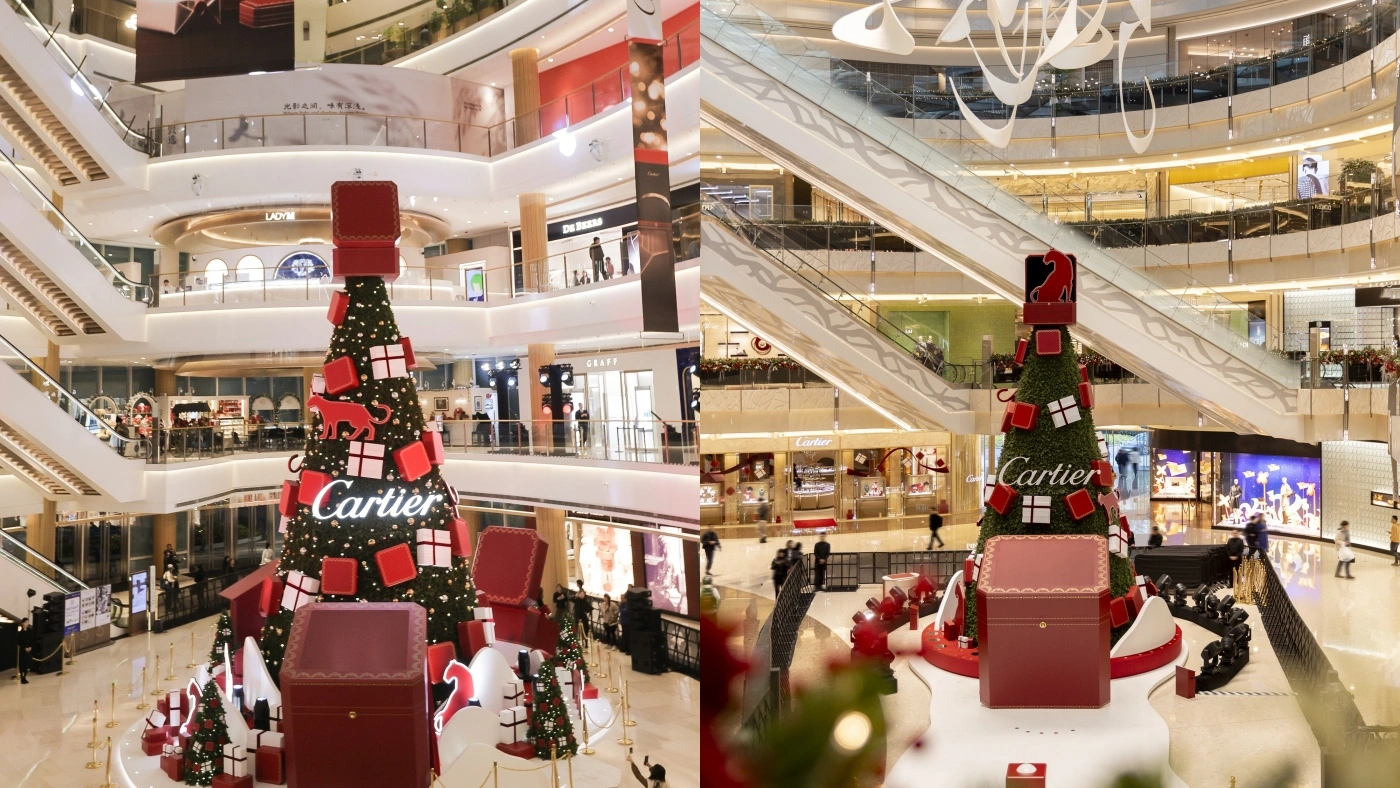
The Cartier “Fantasy Winter” project is a textbook example of a luxury brand’s holiday installation. As the on-site photos show, the design comprises several core elements. At the center of the atrium stands the main Christmas tree, with red gift boxes finished in gold-foil trim and white gift boxes tied with red ribbon suspended from the trunk. Midway up the trunk are illuminated lettering and a glowing red leopard silhouette, while the crown is topped by an illuminated leopard ornament resting on a red gift box. The base takes the form of an undulating white snow-capped mountain, complete with red steps, gilded handrails, an oversized open red jewelry gift box, a red Christmas cottage, and small trees and wreaths placed throughout. The site imagery covers both an indoor multi-level atrium and an outdoor plaza, which places a premium on how well a custom mall installation adapts to its specific venue.
The design draft is only the starting point. On receiving a project, our factory first breaks the brief down into three levels:
Visual Level: The brand’s signature red and the texture of the gold-foil trim must hold up consistently under the mall’s mixed warm and cool lighting, with no color shift and no cheap-looking finish.
Experiential Level: The steps, gift boxes, and Christmas cottage all function as interactive photo-ops, so the structures must withstand sustained foot traffic, and every edge and handrail must be safe to touch.
Engineering Level: Given the sheer size of the main structure and the compressed on-site schedule (malls typically permit access only overnight, after closing), every component must be modular, built for rapid disassembly, quick assembly, and reuse.
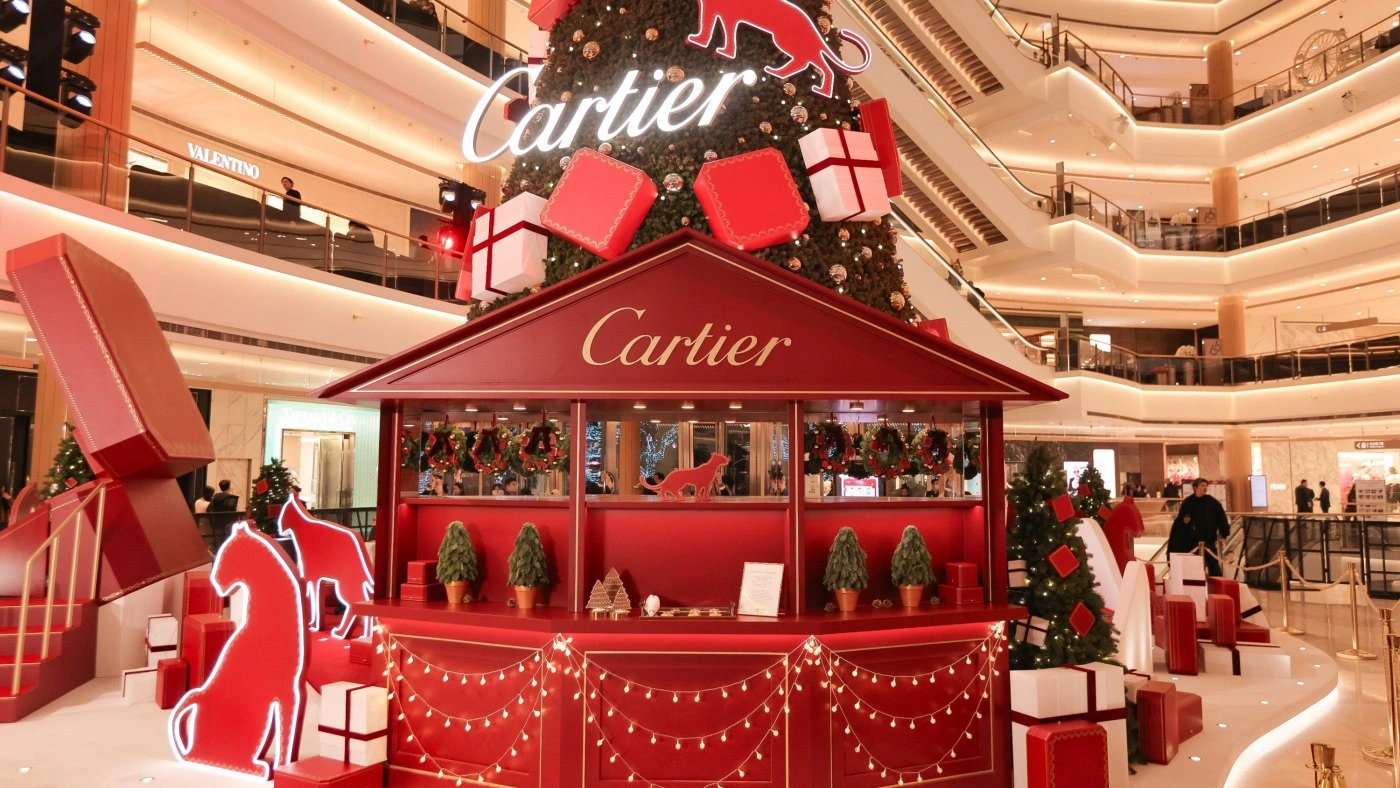
The detailed design phase is the most frequently underestimated stage of a custom mall installation. Renderings depict only the exterior appearance. The factory must translate them into a complete set of shop drawings covering the steel framework, panel breakdown, lighting wiring, connection joints, and packing dimensions. At this stage, we build the 3D model and verify, one by one, the joint locations of the tree frame, the suspension points of the gift boxes, and the snow-capped mountain base. In parallel, we check the maximum envelope of each component against the atrium’s load-bearing capacity, freight elevator dimensions, and corridor widths, so that no one discovers on site that a component will not fit.
Because the Christmas tree is a tall, conical structure, controlling the center of gravity and preventing overturning are the key design priorities. We use a central steel column paired with a ring-shaped framework to carry the primary load. Stability at the base comes from counterweights and an enlarged base plate, which are then concealed beneath the snow-capped mountain base. This preserves visual integrity while protecting the mall floor from direct damage. The gift boxes and leopard light decorations suspended from the tree follow lightweight design principles, using high-strength, lightweight core materials with finished surfaces. A secondary fall-protection device is added at every suspension point to eliminate any risk of falling throughout an extended display period.
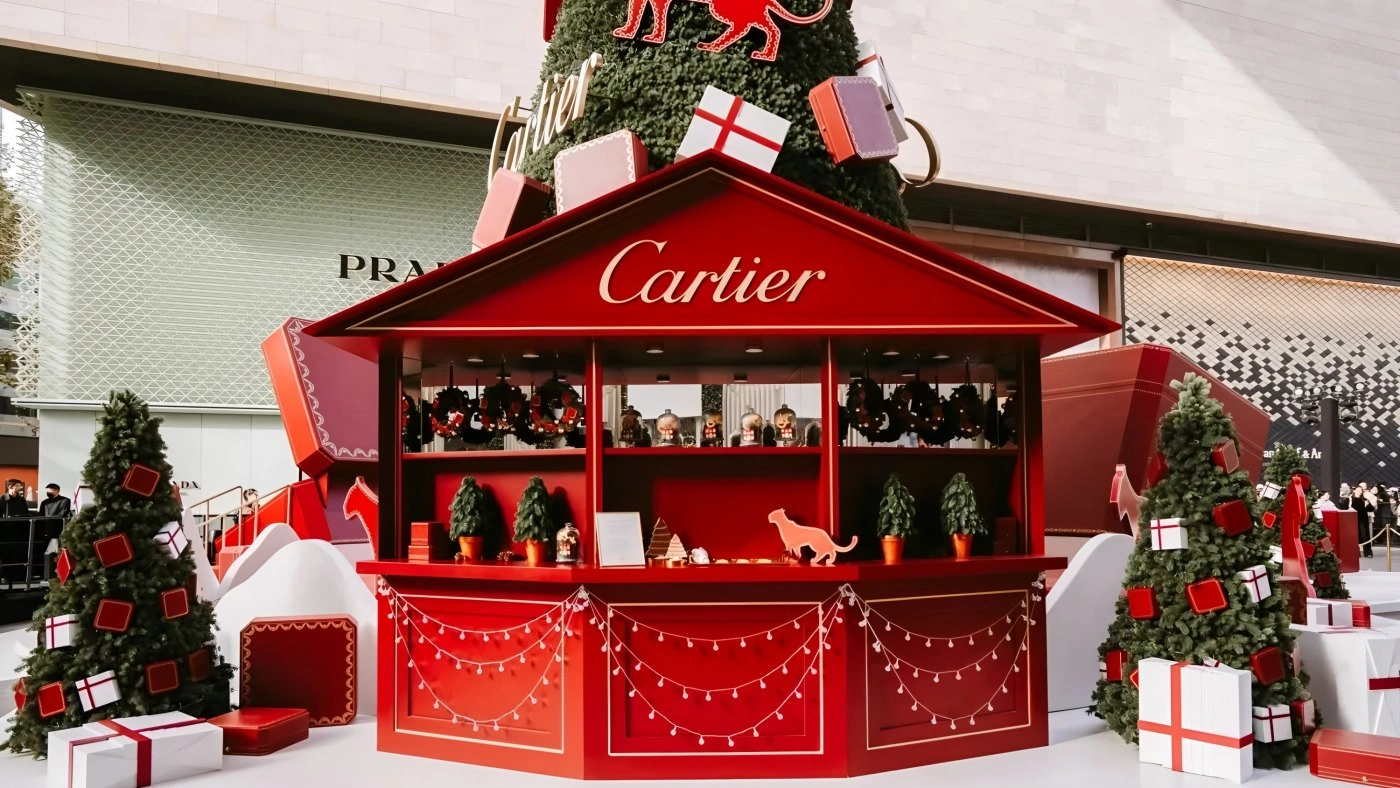
The tree needed to look full while still meeting fire safety requirements, so we specified high-density, flame-retardant artificial foliage. Channels for the light strips were pre-routed within the foliage so that all wiring is fully concealed. The densely clustered lights and small gold ornaments visible on the tree in the photos were likewise pre-installed and illumination-tested at the factory, rather than being placed one by one on site.
The most distinctive feature of this holiday installation is the intricate gold lace pattern on the surface of the red gift box. Through careful surface treatment and hot-stamping, the factory faithfully reproduced the brand’s signature leather texture and patterns at large scale. The box edges feature beveled polygonal cuts, and the interior of the open oversized gift box is lined with black fabric and accented with illuminated trim, which adds depth when lit. The white gift boxes with red ribbons create contrast through a matte white finish and velvet ribbon wrapping.
The illuminated letters and the leopard silhouette are the installation’s most prominent focal points after dark. We fabricated them from acrylic over metal frames with built-in light sources. The leopard silhouette has an evenly lit edge, ensuring no hot spots or dark patches in close-up photography. Light fixtures and power supplies must also meet the certification requirements of the target market. For holiday lighting destined for North America, refer to UL 588, the Standard for Seasonal and Festive Decorations, which covers products such as string lights, garlands, light sculptures, and motorized displays. The standard defines “temporary use” as installation and use not exceeding 90 days, with an input voltage not exceeding 120 volts.
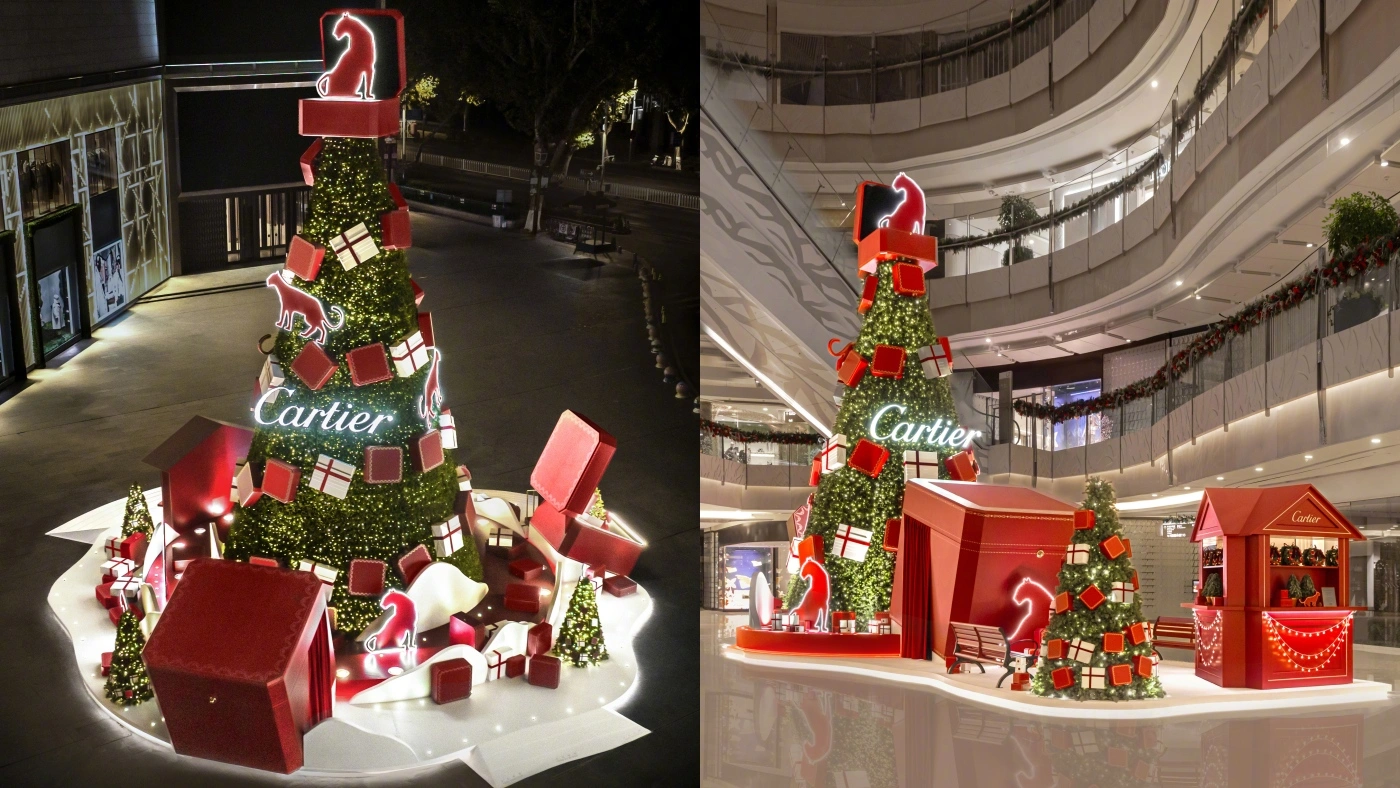
The key difference between custom mall installations and standard exhibits is that they must be fully pre-assembled at the factory. We assemble the tree frame, base, steps, gift boxes, and Christmas cottage in their on-site positions to verify the alignment of every connection point, confirm even joints, and make sure the lighting circuits work correctly. Correcting issues found during factory pre-assembly costs far less than improvised rework during an overnight installation at the mall.
Dimensions and Structure: Re-measurement of critical dimensions; bolt tightness checks at joints; weld inspection on load-bearing components.
Appearance: Color consistency checks; integrity of hot-stamped patterns; panel flatness; rounded edges and corners.
Electrical: Power-on burn-in (aging) test; inspection of light fixtures, power supplies, controllers, and wiring insulation.
Materials: Complete set of flame-retardant material certificates and fire resistance test reports.
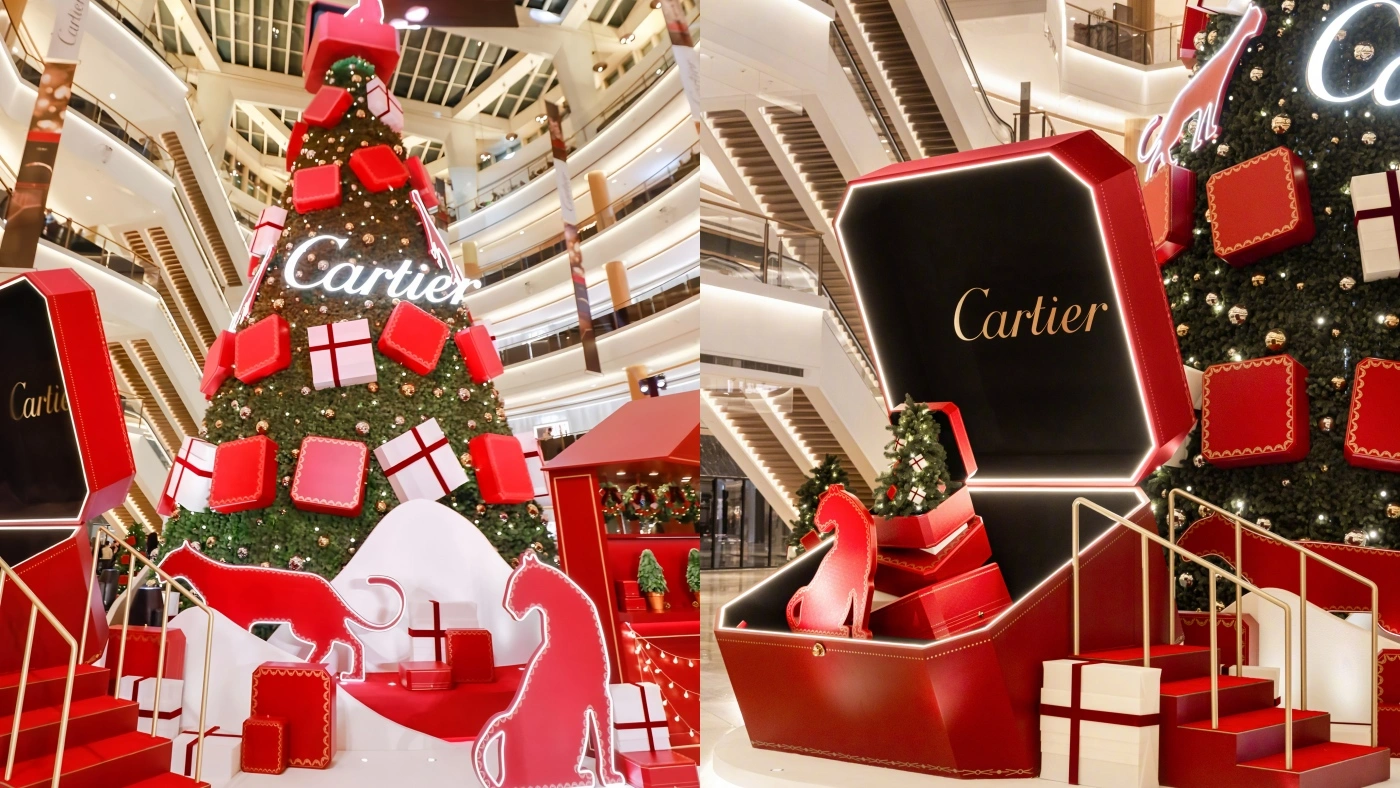
The tall tree trunk is broken down into several ring-shaped modules; the snow-capped mountain base is divided into panels along designated seams; and the gift boxes, leopard silhouette, and Christmas cottage are treated as independent components. Each module carries a unique number that corresponds one-to-one with the on-site installation drawing, so crews can find each position simply by following the numbers. All cable connections use keyed, error-proof connectors to minimize wiring mistakes on site.
Oversized decorative gift boxes and hot-stamped surfaces are especially vulnerable to impact, so we use multi-layer packaging: bubble wrap, corner protectors, wooden frame reinforcement, and moisture-proof film. For export projects, solid wood packaging must also comply with International Standard for Phytosanitary Measures No. 15 (ISPM 15), meaning it must be heat-treated and bear an internationally recognized mark; packaging made from processed wood, such as plywood, falls outside this standard. Planning a compliant packaging solution in advance prevents shipments from being detained or returned at the destination port.
For custom mall installation projects, container loading follows a “last in, first out” principle: components needed first on site are placed nearest the container doors, and the packing list mirrors the installation sequence. We select 20-foot, 40-foot, or high-cube containers depending on project scale. For oversized components, we determine in advance whether open-top or flat-rack containers are required, and we brace the cargo inside the container with wooden wedges and strapping. For cross-border shipments, we also prepare all required documentation ahead of time, including the packing list, commercial invoice, material specifications, and any necessary quarantine documents, to ensure smooth customs clearance and prompt pickup and delivery upon arrival at the port.
On-site installation of custom mall installations differs from work at exhibition venues. The following must be confirmed with property management in advance: entry time, freight elevator use, floor protection, fire safety approvals, and noise restrictions for overnight work. Before load-in, we submit a construction plan, a personnel list, and an emergency response plan, and we lay protective covering over corridors and work areas to prevent damage to high-end flooring such as marble.
Installation proceeds in the order of main structure first, then decorative elements, then lighting: secure the base and central column; hoist the tree body modules layer by layer; hang the gift boxes and illuminated letters; and finally install the snow-capped mountain facades, steps, Christmas cottage, and small trees. Components at height, such as the tree top, are installed from a lift platform; personnel must wear safety harnesses at all times, and an exclusion zone must be established below. Near atrium railings and escalators, temporary barriers must also be erected during installation to guard against falling objects. This integrated transport, unloading, and installation workflow is also our standard procedure for pop-up store installations and large-scale holiday projects.
Lighting calibration comes last. Brightness, color temperature, and control programs are checked circuit by circuit to ensure the red gift boxes show no color shift under the mall’s ambient lighting during operating hours. During the final punch-list inspection, all corners, handrails, interior details, and wreaths in the Christmas cottage are rechecked to guarantee a complete, camera-ready presentation on opening day.
Malls enforce strict fire safety requirements. For the fabrics, velour, and film-based materials used in the installation, we refer to NFPA 701, Standard Methods of Fire Tests for Flame Propagation of Textiles and Films, and obtain test reports from accredited third-party laboratories for review by the mall’s fire safety and property management teams. We request flame-retardant certification at the material procurement stage, then compile and archive these documents together with the factory records.
On the structural side, we verify stability and connection points during pre-assembly and carry out a follow-up inspection of counterweights, bolts, and suspension points after on-site installation. On the electrical side, we run a comprehensive inspection of grounding, ground-fault circuit interrupters (GFCIs), and overload protection, and we reserve a dedicated power connection point so the mall’s engineering department can verify the setup. We also recommend scheduling regular inspections during the display period to promptly address damaged or loose LED bulbs and damage from accidental impact.
Once installation is complete, we work with the brand and the mall to finalize acceptance and provide operating and maintenance instructions. When the display period ends, we strike the installation in reverse order of the installation numbers, then sort and pack the components. After inspection and refurbishment, they can be stored or reused, reducing the cost of the brand’s custom installation for the next season.
Reflecting on the Cartier “Fantasy Winter” project, four key lessons apply to every mall Christmas installation. First, resolve structural and transportation issues up front through detailed design. Second, reduce risk by pre-assembling components at the factory. Third, keep transportation and installation under control through modular numbering and compliant packaging. Fourth, uphold commercial-space safety standards through a three-part inspection covering fire safety, electrical systems, and structural integrity. The same approach carries over to public art installations and brand event environments.
Ixmore Art is a factory specializing in custom installations and props for commercial spaces. Our services span the entire process, from design development and production to international shipping and on-site installation. If you are planning your next custom mall installation for the winter season, we welcome your inquiry. We will propose a practical solution tailored to your venue specifications and budget.
The timeline depends chiefly on the installation’s scale, the complexity of the craftsmanship, the level of detail in the lighting and structural design, the mode of transport, and the efficiency of customs clearance at the destination. The larger the scale, and the more gold-foil stamping and lighting effects involved, the longer the production and pre-assembly lead time. We recommend that brands kick off the project as early as possible once the schedule is locked, leaving sufficient buffer for detailed design and ocean freight.
Yes, but each setting calls for structural and material adjustments. Indoor installations center on fire safety, lightweight construction, and overnight installation; outdoor installations must also account for wind loads, waterproofing and dust protection, foundation anchoring, and ingress protection (IP) ratings for lighting. All of these should be settled during the detailed design phase.
Yes. Solid wood packaging must comply with International Standard for Phytosanitary Measures No. 15 (ISPM 15), be heat-treated, and carry the required mark. We verify packaging compliance across the board before container loading and, where necessary, switch to packaging solutions that fall outside the standard, such as plywood.
We coordinate with property management to access the site after the mall closes at night. Freight elevator and access routes are planned in advance, floor protection and noise-control measures are put in place, and, thanks to modular disassembly and numbering, on-site work is reduced to assembly and commissioning, keeping disruption to foot traffic to a minimum.
Yes. Thanks to their modular structure, the installations can be dismantled, sorted, packed, inspected, refurbished, and reassembled for the next display period or at other venues. The key is to build disassembly points and standard interfaces into the design phase.
It depends on the target market. For North America, holiday lighting should comply with UL 588; in Europe and other regions, it must meet local electrical and fire safety regulations. We recommend confirming the target market at project kickoff so that product selection and documentation can begin early.
Send us your design drafts or reference images, along with the venue dimensions and schedule. We will evaluate the structure, manufacturing process, and logistics, then provide a quotation and a recommended timeline. For more questions, please visit the FAQ page on our website.
July 27, 2026
July 27, 2026
July 27, 2026
July 27, 2026
July 27, 2026
July 27, 2026
July 27, 2026
July 26, 2026
July 26, 2026
July 26, 2026
July 26, 2026
July 26, 2026
July 26, 2026
July 26, 2026
July 26, 2026
July 26, 2026

July 26, 2026
July 25, 2026
July 25, 2026
July 25, 2026